Lulu the black lab has flunked out of the CIA’s elite bomb sniffer school

According to a recent Circa news story

Lulu the black lab might be many things in her life, but being a part of the CIA’s bomb sniffing K9 squad will not be one of them.

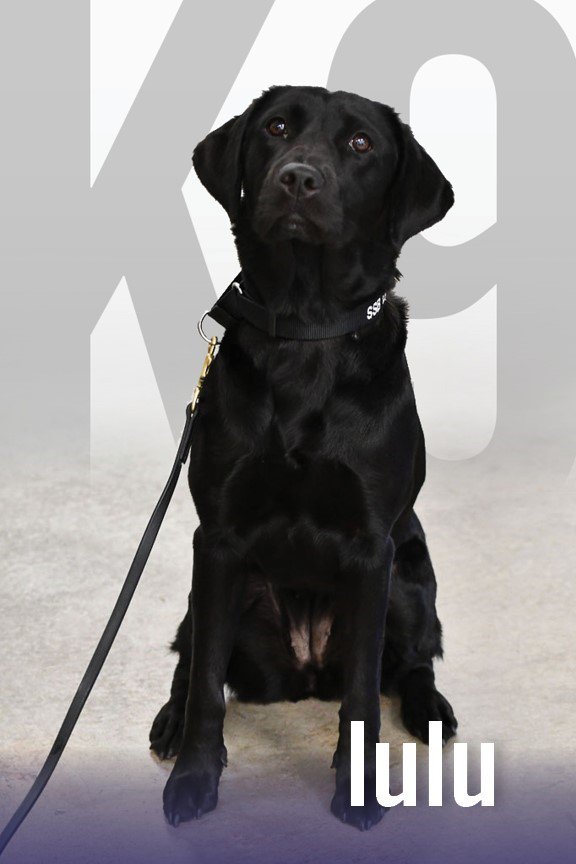
The 18-month-old doggy was admitted to the agency’s explosive detection K9 fall 2017 puppy class, but early on it was clear that job just wasn’t for her.

“A few weeks into training, Lulu began to show signs that she wasn’t interested in detecting explosive odors,” said the CIA in a “pupdate” on their website.

 Pupdate:
Sometimes, even after testing, our pups make it clear being an explosive detection K9 isn’t for themhttp://bit.ly/2gQf3vk pic.twitter.com/07TXRCH7bp

We’re sad to announce that a few weeks into training, Lulu began to show signs that she wasn’t interested in detecting explosive odors. pic.twitter.com/c6lxHPfC09
View image on Twitter

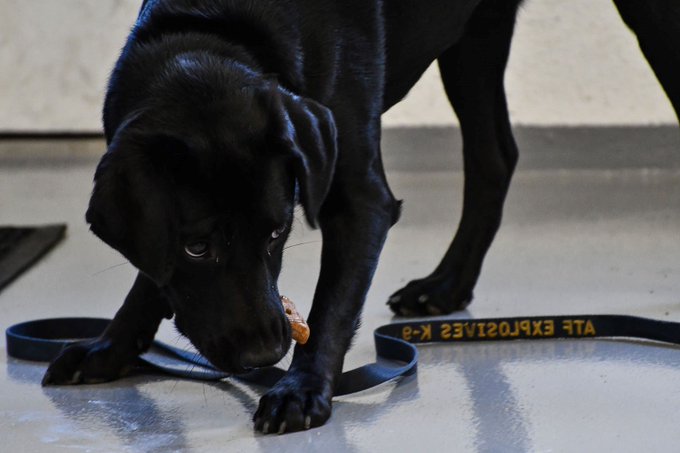
Lulu’s trainers tried their best to motivate her with treats and playtime, but it was clear bomb detection just wasn’t her thing. It’s not uncommon for the puppy trainees to have a bad day during the training course, according to the CIA.

All dogs, like humans, have good & bad days when learning something new.
Same for our pups, though it usually lasts just a day or two. pic.twitter.com/z9lQa2uKX4

There are a million reasons why a dog has a bad day & our trainers must become doggy psychologists to figure out what will help pups. pic.twitter.com/iaeRpGiSUR
View image on Twitter

“A pup might begin acting lazy, guessing where the odors are, or just showing a general disregard for whatever is being taught at the moment,” said the agency. “Usually it lasts for a day, maybe two.”

Trainers have to become “doggy psychologists” in order to determine what’s wrong. Sometimes the trainee is just bored, needs a break or a new challenge. It can also be a physical issue, such as a food allergy. These issues are usually solved within a matter of days.

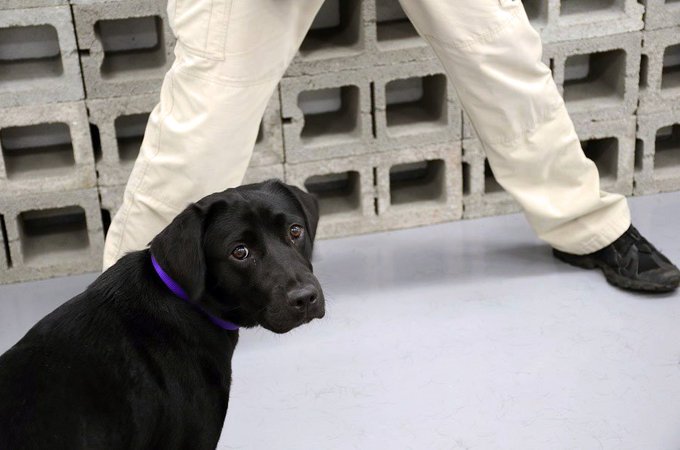
For some dogs, after weeks of working w them, it’s clear the issue isn’t temporary & instead, this just isn’t the job they are meant for. pic.twitter.com/bBjPz8Ng2U

Lulu wasn’t interested in searching for explosives.
Even when motivated w food & play, she was clearly no longer enjoying herself. pic.twitter.com/puvhDk1tRX
View image on Twitter

“But for some dogs like Lulu, it becomes clear that the issue isn’t temporary,” the article explained. “Instead, this just isn’t the job they are meant for. Lulu was no longer interested in searching for explosives.”

The CIA considers the mental and physical health of its K9s a top priority. The agency therefore determined it was best to cut Lulu from the program.

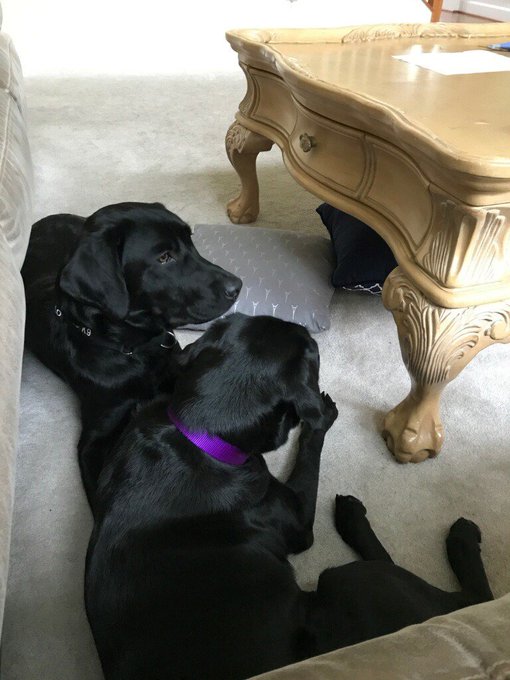
But it’s not all bad news for the lethargic lab. Lulu’s trainer decided to adopt her after she flunked out, a common practice once a K9 is retired. She has also discovered her true passions: sniffing for rabbits and squirrels, playing with her trainer’s kids and chowing down in her dog dish.

When a pup is removed or retires from our K9 program, the handler & their family is given the chance to adopt them & many do. pic.twitter.com/EMfua7zhbT

Lulu was adopted by her handler & now enjoys her days playing w his kids & a new friend, & sniffing out rabbits & squirrels in the backyard. pic.twitter.com/WOImM75P1D
View image on Twitter

A Salute to Seattle Children’s Hospital

Salute to Children’s Hospital by Louis Howard


The hospital was founded as the seven-bed Children’s Orthopedic Hospital in 1907  after The death of Anna Clise’s young son from inflammatory rheumatism in 1898 made her tragically aware of the lack of specialized care for children – and inspired her to take action.

With the help of 23 female friends, Clise established the first facility in the Pacific Northwest to treat these children, most of who would otherwise have been left to endure pain and disability throughout their lives.

Clise’s original vision – to care for children regardless of race, religion, gender or a family’s ability to pay – still guides Seattle Children’s today.

Seattle Children’s, formerly Children’s Hospital and Regional Medical Center, formerly Children’s Orthopedic Hospital, is a children’s hospital in the Laurelhurst neighborhood of Seattle, Washington. n 1953, Children’s moved to a new campus in Laurelhurst, east of the University of Washington   In 2016, it was ranked as the 5th best children’s hospital in America by U.S. News and World Report and was ranked #4 in nephrology, #6 in cancer, #5 in neonatology, #13 in gastroenterology and GI surgery, #11 in pulmonology and #9 in neurology and neurosurgery.[1]


Seattle Children’s was ahead of its time at the turn of the 20th century. The same is true at the turn of the 21st century. Many of our physicians are national leaders in their fields, using their skill and experience to discover new cures and deliver the very latest, best treatments available – all part of our mission to prevent, treat and eliminate pediatric disease.

In 2014, Seattle Children’s received the largest donation in its history: $73.9M from Jack R. MacDonald

Under you Inspire Hope: ways to get involved:

Start A Guild: There is a independent network of Guids with over 5000 volunteers. Many sorts and celebrities support these fundraisers every year. One such Guild is The Imagine Guild.


Twenty One years ago, 100 motorcycles gathered to participate in Children’s Ride 1. The  event was a success raising $13,000 for Children’s Hospital.

                       ~~~~~

In 2009, the Imagine Guild moved the Gala and Auction to the Fremont Studios where John Curley hosted an evening of laughs and fundraising to benefit the kids. We also featured the Bagger Build-off competition between Paul Yaffe/Destination Harley-Davidson and Brian Klock/Downtown Harley-Davidson.

In 2008, CR 13 raised more than $700,000 for Children’s Hospital. Who could have predicted that Children’s Ride would become one of the top five guild fundraisers for Children’s Hospital as well as one of the largest charity motorcycle events in the Pacific Northwest?

The Imagine Guild and Children’s Ride was founded in 1995 by Rick Baldwin. In 1974, Rick’s daughter Tessa was admitted to Children’s Hospital for treatment of third-degree burns when a coffee pot toppled onto her  Being a young father with limited financial resources, Rick benefited from the uncompensated care fund provided by Children’s Hospital. Always wanting to repay the hospital for the care his family received, Rick combined his love for motorcycles with his gratitude to CIn 2005, Children’s Ride grew from a one-day to a three day weekend event. The Children’s Ride Gala and Auction made its debut as a resounding success that year. Attracting one of the top custom motorcycle builders in the industry today, Paul Yaffe built a one-of-a-kind custom chopper for the auction. Excitement was at an all time high in the Hyatt Regency Ballroom as Edgar Martinez of the Seattle Mariners and Chad Eaton, a former Seattle Seahawk, matched each other bid for bid on the custom motorcycle until Edgar offered the winning bid of $95,000.children’s Hospital and the idea for Children’s Ride was born.

Other Ways to Help:

Donate a Toy

Your donation of new toys, gift cards and other items help patients and families when they need comfort Ways to Donate

New Housing Data for September

Below is recent sales data for Seattle & King County courtesy of NWMLS.

Housing & Economic  Update:


September 2017 Number MOM YOY Buyers Sellers
Active Listings 3,104 +10.1% -16.1%
Closed Sales 2,512 -10.2% -0.2%
SAAS (?) 1.17 -2.7% -3.9%
Pending Sales 2,736 -11.0% -6.3%
Months of Supply 1.24 +22.6% -15.9%
Median Price* $625,000 -3.8% +16.2%

DOW Sets New Record

Dow touches 23,000 for the first time, closes at record

  • The Dow reached 23,000 for the first time. The index first closed above 22,000 on Aug. 2.
  • Boeing and Caterpillar were the biggest points contributors on the Dow since Aug. 2, when the index first broke above 22,000.
  • On Tuesday, the index was buoyed by UnitedHealth, which reported a stronger-than-expected quarterly profit and raised its full-year adjusted earnings forecast.

A Look At Our National Anthem

Louis Howard. With all the conversation and actions centered around the anthem sporing events. I explored the history of the national anthem in the USA.

The History Of the national Anthem


  • The anthem was originally a poem written by Francis Scott Key
  • The poem was originally called “ In Defence of Fort McHenry was written after Key witnessed the Maryland fort being bombarded by the British during the war of 1812.
  • Key was inspired by the sight of a lone U.S. flag still flying over Fort McHenry at daybreak, as reflected in the now-famous words of the “Star-Spangled Banner”: “And the rocket’s red glare, the bombs bursting in air, Gave proof through the night that our flag was still there.”
  • Francis Scott Key was born on August 1, 1779 He became a successful lawyer in Maryland and Washington, D.C., and was later appointed U.S. attorney for the District of Columbia.
  • On June 18, 1812, America declared war on Great Britain after a series of trade disagreements. In August 1814, British troops invaded Washington, D.C., and burned the White House, Capitol Building and Library of Congress. Their next target was Baltimore.
  • After one of Key’s friends, Dr. William Beanes, was taken prisoner by the British, Key went to Baltimore, located the ship where Beanes was being held and negotiated his release. However, Key and Beanes weren’t allowed to leave until after the British bombardment of Fort McHenry. Key watched the bombing campaign unfold from aboard a ship located about eight miles away.  On a rainy September 13, 1814, British warships sent a downpour of shells and rockets onto Fort McHenry in Baltimore Harbor, relentlessly pounding the American fort for 25 hours. The bombardment, known as the Battle of Baltimore,
  • the British were unable to destroy the fort and gave up. Key was relieved to see the American flag still flying over Fort McHenry and quickly penned a few lines in tribute to what he had witnessed. The poem was printed in newspapers and eventually set to the music of a popular English drinking tune called “To Anacreon in Heaven” by composer John Stafford Smith.


  • In 1931, It became the theme for America People began referring to the song as “The Star-Spangled Banner” and in 1916 President Woodrow Wilson announced that it should be played at all official events. It was adopted as the national anthem on March 3, 1931.


  • Today, the flag that flew over Fort McHenry in 1914 is housed at the Smithsonian Institution’s Museum of American History in Washington, D.C.


Website Powered by WordPress.com.

Up ↑